
CAREER DATA · NOVEMBER 7, 2026
AI Is Showing Up in More Job Postings in Every Country We Tracked
By READY · AI-assisted editorial
The share of job postings that mention artificial intelligence grew in every one of the nine countries Indeed Hiring Lab tracks between the third quarter of 2025 and the third quarter of 2026. In some places it more than tripled.
We looked at Indeed Hiring Lab's AI Tracker, a free public dataset that measures the share of job postings on Indeed that include AI-related keywords such as "machine learning," "data science" and "artificial intelligence." We averaged the daily figures by quarter and compared July to September 2026 with the same months a year earlier.
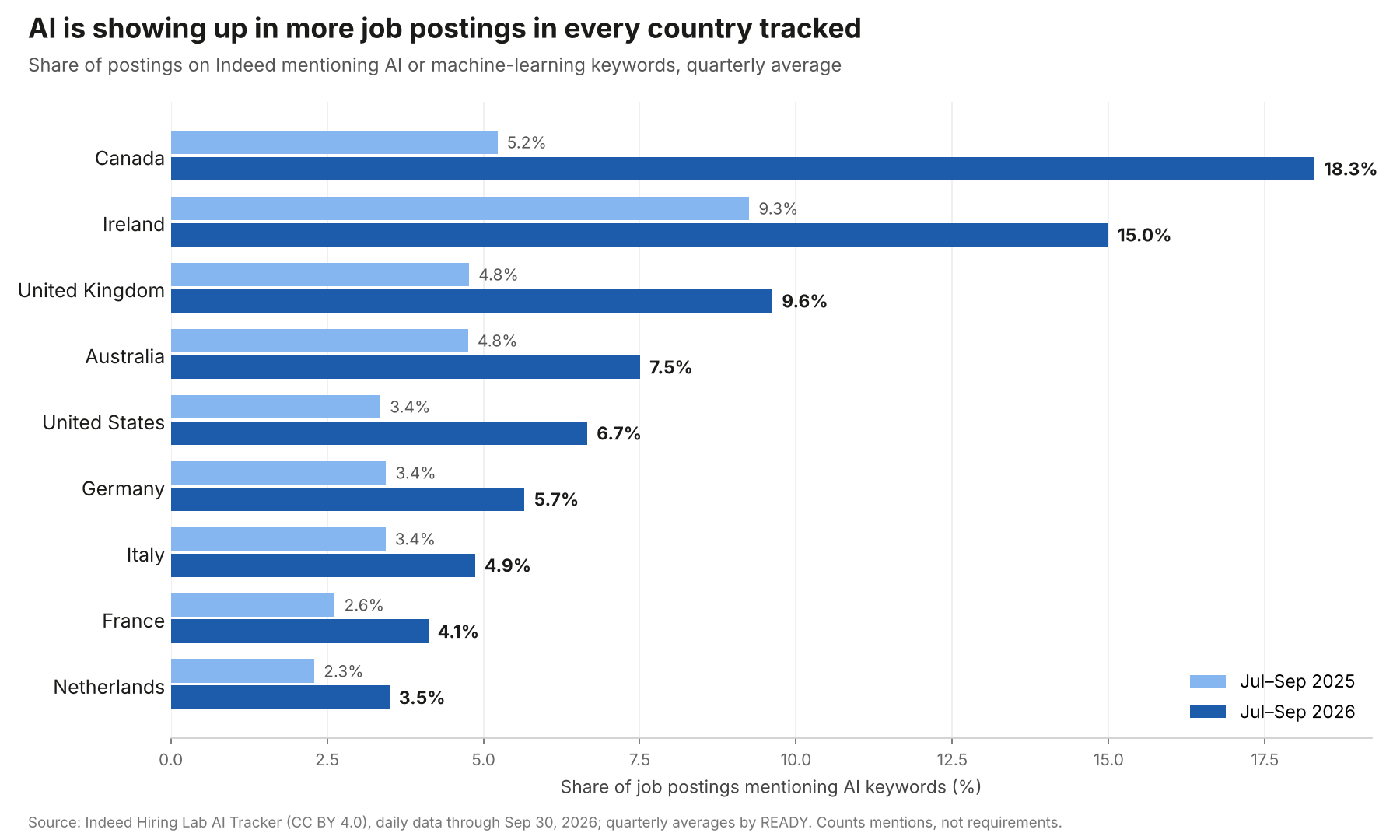
| Country | Jul–Sep 2025 | Jul–Sep 2026 |
|---|---|---|
| Canada | 5.2% | 18.3% |
| Ireland | 9.3% | 15.0% |
| United Kingdom | 4.8% | 9.6% |
| Australia | 4.8% | 7.5% |
| United States | 3.4% | 6.7% |
| Germany | 3.4% | 5.7% |
| Italy | 3.4% | 4.9% |
| France | 2.6% | 4.1% |
| Netherlands | 2.3% | 3.5% |
Three findings
1. The rise is everywhere. All nine countries in the data (Australia, Canada, France, Germany, Ireland, Italy, the Netherlands, the United Kingdom and the United States) saw a larger share of postings mention AI in Q3 2026 than in Q3 2025. The smallest increase was about 40% (Italy, from 3.4% to 4.9%). The largest was Canada, where the share more than tripled.
2. In the United States, the share roughly doubled in a year. About 6.7% of US postings mentioned AI keywords in Q3 2026, up from 3.4% a year earlier, or roughly one posting in fifteen. In early 2023 it was about 2.1%.
3. Canada, Ireland and the UK lead. In Canada, 18.3% of postings mentioned AI keywords in Q3 2026, more than one in six, up from 5.2% a year earlier. Ireland was at 15.0% and the United Kingdom at 9.6%, about one in ten.
What this does and doesn't show
These figures count job postings that mention AI keywords. That includes postings for AI and data-science roles themselves, and postings for other roles that mention AI tools or skills. The data doesn't separate the two, and it doesn't show that entry-level jobs now require AI skills. A mention can be a requirement, a nice-to-have, or a description of the team's tools.
The data also doesn't explain why the share is rising faster in some countries. Canada's rise has been steady, week after week since late 2025, rather than a single jump that might suggest a change in how postings are counted. We report it as Indeed publishes it.
What it means for people preparing for a new role
If you're changing careers or applying for your first job in a field, expect AI to come up, in the posting, in the interview, or in the work itself. That doesn't mean every candidate needs to be an AI specialist. In most roles, the useful skill is judgment: using AI tools to get a first draft faster, then checking whether the output is right, noticing what it missed, and explaining your reasoning.
Three practical steps:
- Read postings for how AI is mentioned. Is it a requirement, a preference, or a description of the tools the team uses? Prepare accordingly.
- Practice checking, not just producing. Take an AI-drafted summary, query or plan in your field and find what's wrong with it. Write down how you'd fix it.
- Bring evidence. One short example of a time you caught an error in AI-assisted work is more convincing in an interview than a list of tools.
READY's free training includes practice built around these judgment skills in cybersecurity, data, project management, IT and customer success. A free account is required, and there's no charge for the training. Browse free training
Method and source
Source: Indeed Hiring Lab, AI Tracker (github.com/hiring-lab/ai-tracker), licensed CC BY 4.0. The data is the share of job postings on Indeed that include AI-related keywords, as a seven-day trailing average, by country. READY averaged the daily values by calendar quarter (Q3 = July 1 to September 30). Data through September 30, 2026. Figures are rounded to one decimal place. READY is not affiliated with Indeed.